Exhibition
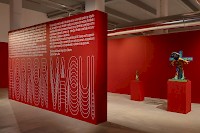
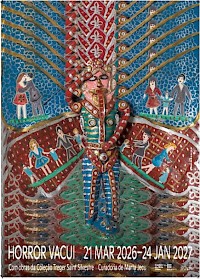
Horror Vacui
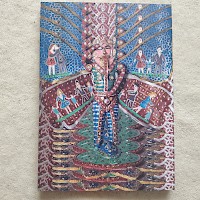
An Incursion into the Treger Saint Sylvestre Collection
21 March 2026 — 24 January 2027
Treger Saint Sylvestre Collection
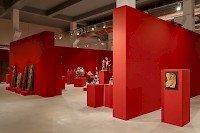
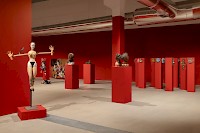
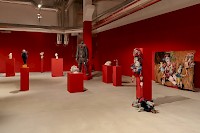
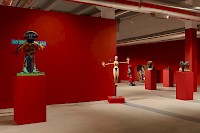
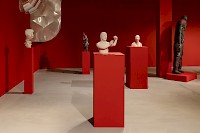
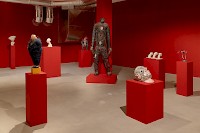
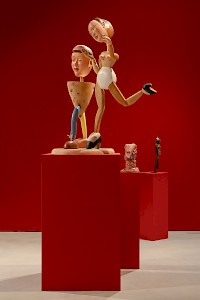
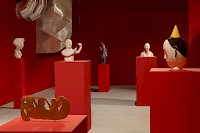
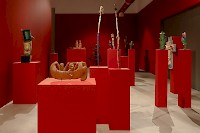
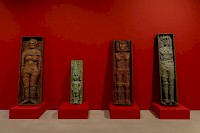
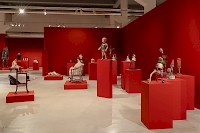
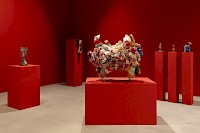
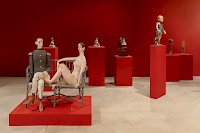
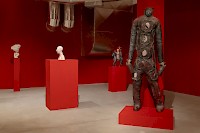
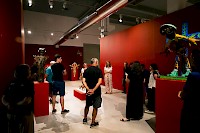
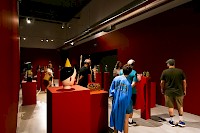
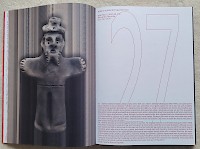
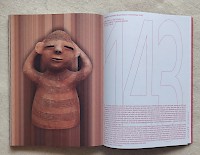
A collective exhibition with works of the Treger Saint Sylvestre Collection (88 Sculptures)
With a sound piece by the Portuguese writer: Gonçalo M. Tavares
Curator: Marta Jecu
Curatorial Text HORROR VACUI
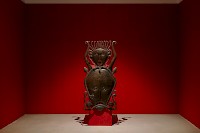
Eighty-eight anthropomorphic figures from the Treger Saint Silvestre Collection—animals, machines, spirits, humans, monsters, and angels—open up a tumultuous field in which anarchy and excess act as protective mechanisms against ontological uncertainty. Filling the void becomes a strategy of existential stabilisation.
The term horror vacui came to mind because it synthetises this oscillation between being and environment, in a psychological and cosmological way, while also functioning as expression and manifestation. On the one hand, it can be seen not as a fear but as a freedom to inhabit the infinite space around us and at our disposal: filling it with overflowing imagination, manifesting a profusion of references and associations in a free development, uncensored by convention and intervention. The term evokes an awareness of the infinite growth and expansion present in nature, with a force that surpasses human agency. On the other hand, anxiety in the face of the void and the need to fill the universe—compulsively and without discernment—with one's own projections can suffocate the subject in an uncontrolled, unstructured amalgamation where elements become indistinct.
Introduced into the history of art, this term gave rise to a particular aesthetics that is less concerned with ornament than with a way of experiencing the world: a mixture of intense freedom and acute torment. This exhibition explores precisely this ambiguity. It seeks to bring the viewer close—very close—to the infinite “alter egos” of the artists (and of oneself), which speak through these sculptures.
Rather than a fixed concept, horror vacui operates as a diagnostic tool, revealing cultural ways of negotiating the void. It designates our existential condition of being subjected to all-encompassing cosmological “emptiness” and ultimate dissolution. The filled surface, by contrast, functions as protection: repetition, ornament, and saturation stabilise perception and guard against disintegration.
In 1998, Ernst Gombrich was among the first writers to propose a psychological interpretation of horror vacui as an artistic principle in Islamic and European medieval art.1 Medieval horror vacui, as observed in illuminated manuscripts and decorated stone church capitals, was linked to the very idea of Creation, conceived as the filling of emptiness with form and meaning—a plenum. In this world of divine order, horror vacui asserts that all natural forms are interconnected, with everything participating in a continuous profusion of being. The aesthetic impulse to fill space thus mirrors the cosmological need to sustain divine coherence and grace of manifestation in all forms of being.
This exhibition seeks to capture not only how conventions can be defied, but also the humour of inhabiting space and oneself with excess, freedom, and restlessness. These anthropomorphic sculptures seem deeply anti-modern as they open up a territory that stands in opposition to modern valorisations of abstraction, silence, spatiality, synthesis, and containment, affirming confusion, irrational accumulation, oscillation, and vehemence. They reinforce and dismantle the principles of contemporary art, transgressing convention and extending limits. Distinctions like outsider art, street art, marginal art, kitsch, or non-art—so arduously contested—seem futile here. Challenging heritage and its claims to meaning and form, and emerging from a transversal field of non-dogmatic, non-disciplinary expression, these works, voices, answers, or doubts and certainties, neither programmatically affirm the canons of art nor seek to escape them. What is termed art brut or art singulier is simply there: the ingenuous consequence of multiple temporalities and scales, of unperceived relations, of events and interactions that remain unknown—constantly reinventing the history of art and the right to unmediated expression. They are political insofar as they resist control, convention, meaning itself, and the dominance of visual cultures embedded in and legitimised by “tradition.”
Recently, posthuman and ecological thought has also destabilised the notion of empty space by rejecting human-centred perceptual criteria. What appears void to human senses may be densely populated by non-human agencies: microbial life, chemical processes, electromagnetic forces. There are no empty landscapes, only unperceived relations. Space is always already inhabited by multiple temporalities and scales. From an ecological perspective, the void no longer threatens: it hosts future transformations and a multiplicity of relations.2
Like the Treger Saint Silvestre Collection, this assembly of human and other-than-human beings watching over the viewer carries these references and more in its specific, amalgamated way. It also closely reflects, in its immediacy, our cyber-multiplied world, suffocated by data and images, both imaginary and digitally generated. It transmits existential and ecological hysteria, embodying relations, beings, forces, and agencies that overflow what is possible.
A significant part of the exhibition consists of the philosophical contribution of the Portuguese author Gonçalo M. Tavares. His text, written especially for this exhibition situates the heavy, handcrafted, dusty, time-worn sculptures on view within a precise meta-narrative. Presented as a sound piece, it resonates throughout the exhibition spaces and accompanies visitors along their journey.
1 Ernst Gombrich, The Story of Art (New York: Phaidon Press, 1998).
2 Jane Bennett, “Systems and Things: On Vital Materialism and Object-Oriented Philosophy,” in Richard Grusin (ed.), The Nonhuman Turn (Minneapolis, London: University of Minnesota Press, 2015).
(Marta Jecu)